ChatGPT Attractiveness Test: Can ChatGPT Really Rate Your Face?
A practical guide to using ChatGPT for photo feedback without treating one conversational answer as a real beauty score.
Table of Contents
Search interest around a ChatGPT attractiveness test usually comes from a simple question: if ChatGPT can read images, can it look at a selfie and tell you whether you are attractive? The honest answer is more nuanced than yes or no. A conversational AI can often discuss visible photo conditions, explain why a selfie may look harsh, and help you write a more balanced self-check. But a direct beauty verdict from one image is still a weak signal. It depends on the uploaded photo, the prompt, model behavior, privacy rules, and the emotional state of the person asking. This guide explains how to use ChatGPT more safely, how it differs from a dedicated AI face rater, and when it is better to stop asking for a score.
Can ChatGPT Rate Your Face?
If image input is available in your ChatGPT experience, you may be able to ask about a photo. The safer use is to ask for image-quality feedback rather than a final attractiveness score. ChatGPT is designed as a general assistant, not a calibrated beauty-measurement instrument. It can describe whether a photo is close, dark, tilted, cropped, blurry, or strongly shadowed. It may also suggest how to retake a clearer portrait. That is different from saying your face is objectively a 6, 7, or 8.
Use it as photo feedback, not a verdict
- Ask about lighting, angle, expression, crop, and presentation before asking about attractiveness.
- Do not treat one ChatGPT response as an objective beauty score.
- Avoid prompts that push the model to label you harshly or compare you to other people.
- Use a dedicated face rater when you want structured photo scoring and a consistent output format.
What a ChatGPT Attractiveness Test Can and Cannot Do
The key is separating helpful visual reasoning from unreliable identity or worth judgments. A good prompt keeps the task narrow, practical, and image-focused.
| Request | Fit for ChatGPT | Better use |
|---|---|---|
| Rate my face out of 10 | Weak fit because the number sounds more precise than it is. | Use a dedicated face rater, then read the score as photo feedback. |
| Why does this selfie look bad? | Good fit when the answer stays about lighting, camera distance, crop, and expression. | Ask for specific retake suggestions. |
| Am I ugly? | Poor fit because it turns one image into a personal label. | Ask what photo conditions may be creating an unflattering result. |
| How can I look better in this photo? | Useful if framed as presentation advice rather than identity judgment. | Ask for neutral, practical changes such as softer light or eye-level distance. |
| Is this AI score accurate? | Useful as an explanation task, not as a final appeal. | Compare several clear photos and check whether the pattern is stable. |
ChatGPT Face Rater vs a Dedicated AI Face Rater
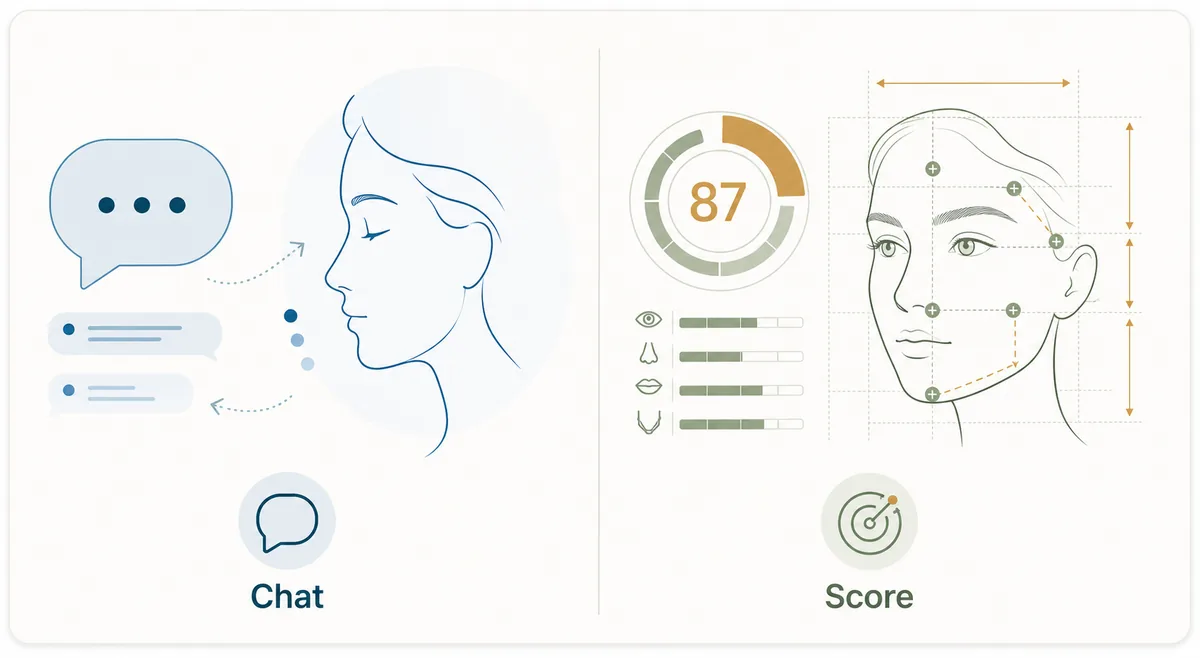
A chat assistant and a scoring tool solve different problems. ChatGPT is flexible and explanatory. A dedicated face rater is more structured: it can ask for the right kind of image, return a consistent scale, and keep the result tied to photo conditions.
| Factor | ChatGPT | Dedicated face rater |
|---|---|---|
| Best use | Explaining why a photo may feel unflattering and how to improve it. | Returning a structured face score with a predictable output. |
| Consistency | Can vary with the wording of your prompt and the model response. | Usually more consistent because the same pipeline evaluates each image. |
| Privacy question | Depends on the platform, account settings, and how image uploads are handled. | Depends on the site policy; look for clear deletion and retention statements. |
| Emotional safety | Can be redirected toward kinder, practical feedback. | A score can feel harsh if you read it as a personal label. |
| Best next step | Use for photo critique and balanced interpretation. | Use when you want a score, then read it alongside lighting and angle notes. |
A Safer Workflow If You Want to Try It
If you still want to use ChatGPT around a selfie, make the workflow reduce distortion instead of amplifying insecurity.
1. Start with a fair image
Use a recent front-facing photo in soft light, taken from eye level and not too close to the lens. A bad close selfie can exaggerate normal features and make any tool overreact.
2. Ask for photo conditions first
Before asking whether you look attractive, ask what the photo conditions are doing. This keeps the answer anchored to visible, changeable details.
3. Request practical retake advice
Ask for two or three concrete improvements such as moving closer to a window, lifting the camera to eye level, relaxing the expression, or increasing distance from the phone.
4. Compare a few controlled photos
If every answer changes dramatically, the tool is reacting to image conditions. If the same advice repeats, the useful signal is probably the photo setup, not a fixed beauty label.
5. Stop if it becomes compulsive
If you keep uploading images to confirm a negative belief, the next useful step is a break, not another prompt.
Better Prompts Than “Rate My Face”
These prompts keep the task useful while avoiding a harsh score-first interaction.
- What photo conditions might make this portrait look less flattering?
- Give me neutral, practical advice to retake this photo with better lighting and angle.
- What should I not over-interpret from this image?
- If an AI face rater gave this photo a low score, what image-quality factors could explain it?
- Help me compare these photos for lighting, crop, and expression, not personal worth.
Privacy and Self-Image Risks to Keep in Mind
Face photos feel personal because they are personal. The risk is not only technical privacy; it is also how quickly a score can become a story about your worth.
Image privacy
Before uploading a face photo anywhere, check whether the service explains storage, retention, training use, and deletion. If the policy is vague, do not upload a photo you would not want stored.
False precision
A number can feel scientific even when it is based on one imperfect image. Lighting, camera distance, lens distortion, grooming, and expression can move a result more than your actual face changes.
Comparison loops
Prompts that ask whether you are better or worse than another person can quickly become harmful. A more useful question is whether the photo represents you fairly.
Mental health boundary
If appearance checking interrupts sleep, school, work, relationships, or normal social plans, treat that as a signal to step away and talk to someone you trust.
FAQ
References
- OpenAI usage policies - Current policy context for image, biometric, and sensitive-personal-data requests.
- OpenAI Help Center: image inputs - Official help article about using images in ChatGPT.
- NIST Face Recognition Vendor Test - Technical background on image quality and face analysis evaluation.
- APA Dictionary: halo effect - Background on how one impression can influence broader judgments.
Last updated: July 5, 2026