Facial Thirds Guide
Measure face thirds and read the 1:1:1 pattern.

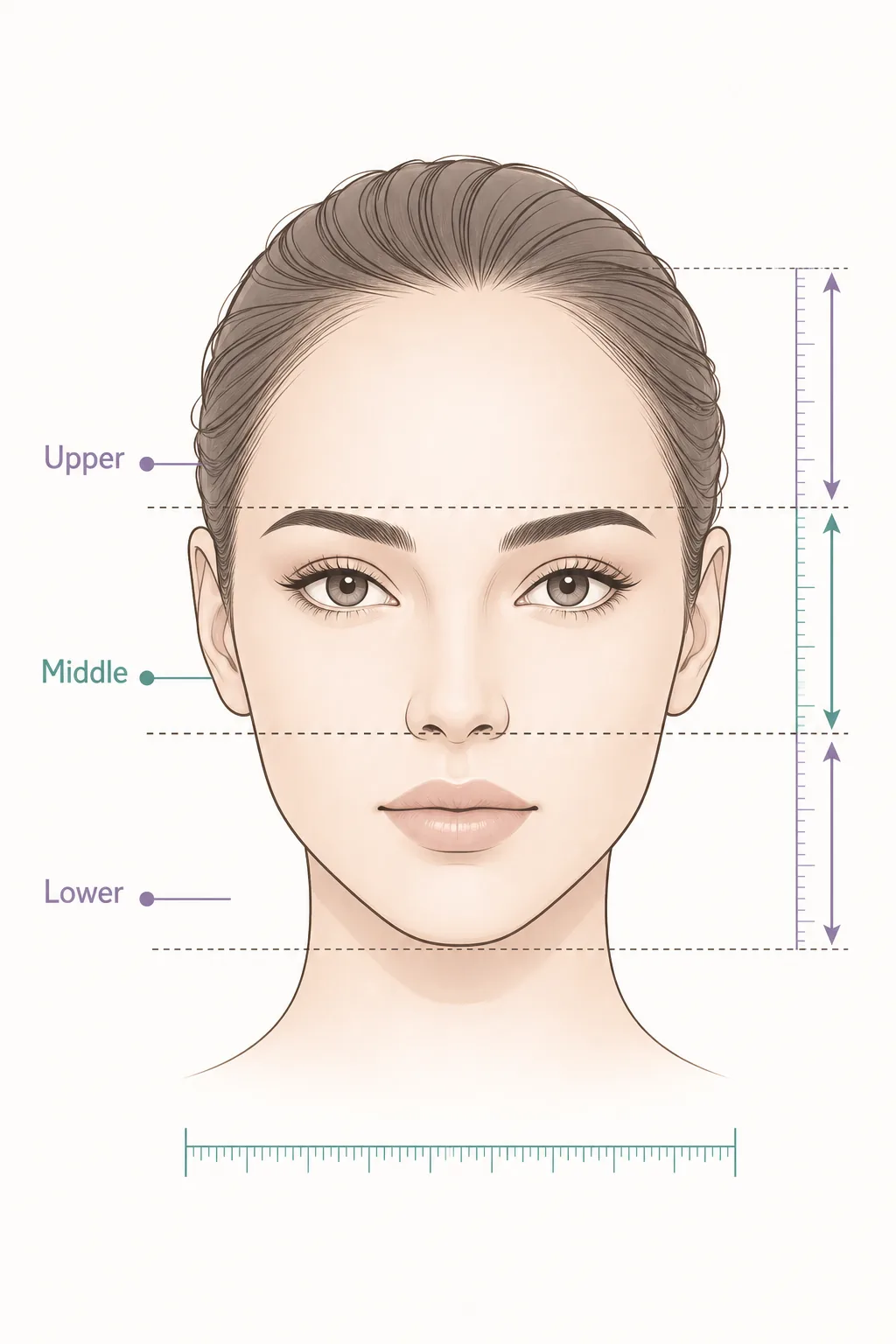
Table of Contents
Searches for facial thirds usually come from people who want a clearer way to understand face proportions than a vague beauty score. The idea is simple: divide a straight front view of the face into three vertical sections and compare whether those sections are close in height. The method is useful because it gives you a repeatable language for proportion. It is also easy to overread. A person can have slightly longer upper, middle, or lower thirds and still look balanced, expressive, and attractive in real life.
What Are Facial Thirds?
Facial thirds are a classic face-analysis framework. In the common version, the upper third runs from the hairline to the brow line, the middle third runs from the brow line to the base of the nose, and the lower third runs from the base of the nose to the bottom of the chin. When the three sections are close to equal, people often describe the face as vertically balanced.
The framework appears in aesthetic, orthodontic, portrait, and makeup discussions because it is easy to explain and easy to compare. It does not replace a full face analysis. It says little about left-right symmetry, facial width, eye spacing, jaw shape, skin texture, expression, or style. That is why facial thirds work best as one proportion check, not as a complete attractiveness score.
A useful reading is usually directional: which section appears shorter or longer, whether the difference is obvious or mild, and whether a photo angle is exaggerating it. If you measure from a tilted selfie, a wide-angle camera, or a raised chin, the result can shift enough to mislead you.
Use facial thirds as a proportion map
- Equal facial thirds are often described as a 1:1:1 vertical balance, not a strict rule every face must match.
- Hairline position, brow height, nose length, chin projection, camera angle, and expression can all change the visual reading.
- A face can be attractive with uneven thirds because harmony also depends on width, symmetry, features, styling, and personality.
- The best use is comparison: measure from a straight view, retest once, then pair the result with a broader face analysis.
How to Measure Facial Thirds
You do not need a perfect studio setup. A clear front-facing photo, a simple ruler tool, and consistent landmarks are enough for an educational check. Use the same unit for all three sections and write down the measurements before judging the result.
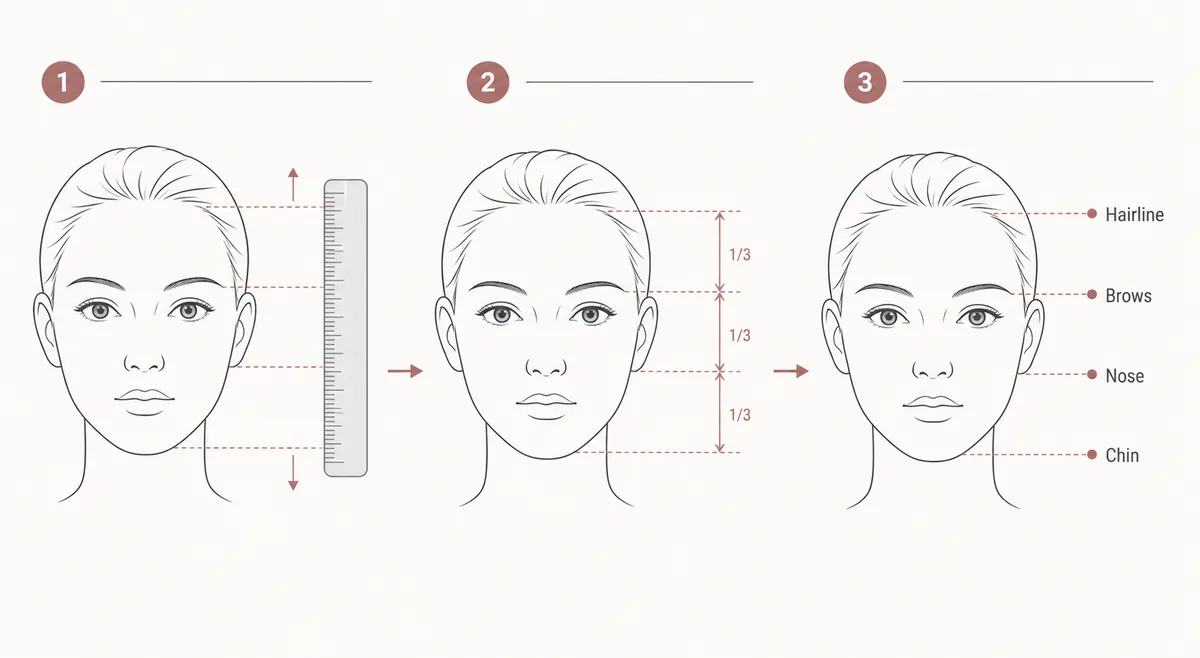
1. Start with a straight front view
Use a photo where the face is level, the camera is near eye height, and the head is not tilted. Avoid close wide-angle selfies because they can stretch the nose and lower face.
2. Mark the four horizontal landmarks
Place one line at the visible hairline, one at the brow line, one at the base of the nose, and one at the bottom of the chin. If the hairline is hidden, note that the upper third will be an estimate.
3. Measure each section separately
Measure hairline to brows, brows to nose base, and nose base to chin. The exact unit can be pixels, centimeters, or inches as long as the same unit is used across the full face.
4. Convert the numbers into a ratio
Divide each third by the average of all three. Values close to 1.00 are balanced. A mild difference is common; a large difference is a proportion signal to interpret with context.
What Each Facial Third Usually Tells You
The table below keeps the reading practical. It is not a diagnosis and it is not a beauty verdict. It helps you describe where vertical proportion is coming from.
| Facial third | Landmarks | Common issue | How to read it |
|---|---|---|---|
| Upper third | Hairline to brow line | Can look longer with a high hairline or shorter with low bangs | Useful for reading forehead height, but hair styling can change the apparent balance. |
| Middle third | Brow line to base of nose | Can look longer if the nose appears visually dominant | Connects to midface length and nose proportion; camera distance can exaggerate it. |
| Lower third | Base of nose to bottom of chin | Can shift with mouth posture, chin angle, facial hair, or expression | Helpful for reading jaw and chin balance, but the easiest third to distort in photos. |
How to Interpret Balanced or Uneven Facial Thirds
A balanced result means the three vertical sections are close in height. It does not mean the face is automatically more attractive, and an uneven result does not mean something is wrong. Read the pattern together with the full face.
Equal thirds are a reference, not a pass-fail test
The 1:1:1 idea is useful because it gives a clean reference point. But real faces rarely match it exactly. A few percentage points of difference can be invisible in normal interaction.
The lower third is easy to misread
Expression, lip posture, chin angle, facial hair, and camera height can all change the apparent lower third. Retest with a relaxed mouth and level camera before drawing conclusions.
Facial thirds are different from golden ratio analysis
Facial thirds compare vertical sections. Golden ratio analysis compares selected width and length proportions against a mathematical reference. The two checks can support each other, but they answer different questions.
Use the result for presentation decisions
If one third reads much longer or shorter in photos, practical changes such as camera height, hairstyle, beard shape, glasses, neckline, or makeup placement can affect the visual balance without changing your face.
Common Facial Thirds Measurement Mistakes
Most confusing results come from the setup, not from the face. Fix these issues before comparing your numbers.
| Mistake | What it does | Better approach |
|---|---|---|
| Using a tilted selfie | Makes one section look longer and can skew the lower face | Use a straight, eye-level photo with the head upright. |
| Guessing a hidden hairline | Turns the upper third into a rough estimate | Mark it as estimated or use a photo where the hairline is visible. |
| Measuring once and treating it as final | Small landmark errors can look like a real proportion issue | Measure twice and compare the pattern, not one exact number. |
| Comparing yourself to a single ideal face | Ignores natural variation, culture, expression, and style | Use facial thirds as one clue among several proportion checks. |
Facial Thirds FAQ
Sources and Further Reading
- National Library of Medicine: Anthropometric facial proportion research - Useful background for how facial proportions are discussed in anthropometry and aesthetic analysis.
- Am I Pretty Face Symmetry Test - Related internal tool for manual symmetry and facial thirds measurement.