Canthal Tilt: Positive, Neutral and Negative Eye Angle Explained
A careful guide to reading the line between your eye corners—without turning one feature, one selfie or one trend into a beauty verdict.

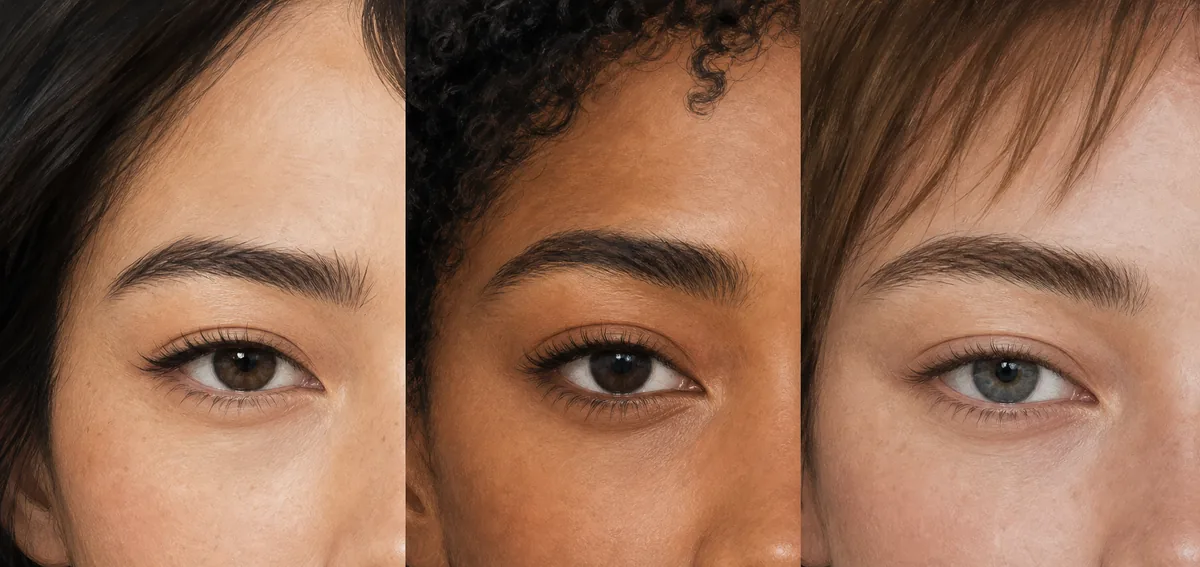
In this guide
Canthal tilt is the direction of the line that joins the inner corner of an eye to its outer corner. If the outer corner sits higher, the tilt is described as positive. If both corners are close to level, it is neutral. If the outer corner sits lower, it is negative. That is the useful definition; it does not require a beauty score or a claim that one type is universally best.
The term has become popular in beauty-analysis and looks-focused communities, but it also refers to real eyelid anatomy. The medial canthus is the corner nearest the nose, and the lateral canthus is the corner nearest the temple. Clinicians consider the position and support of these structures when evaluating eyelid function or planning treatment. A casual photo check can describe appearance, but it cannot replace a clinical examination.
What Does Canthal Tilt Mean?
Imagine one point at the visible inner corner and a second point at the visible outer corner of the same eye. The canthal-tilt line connects those two points. Compare it with a true horizontal reference while the head is level. A rising line is positive, a nearly horizontal line is neutral, and a falling line is negative.
This angle is related to, but not identical with, an eye-shape label. An almond eye can have a positive, neutral or negative tilt. Hooding, crease height, scleral show, brow position and cheek support can make two eyes with a similar corner angle look very different. That is why the broader eye-shape guide should be used alongside this narrower measurement.
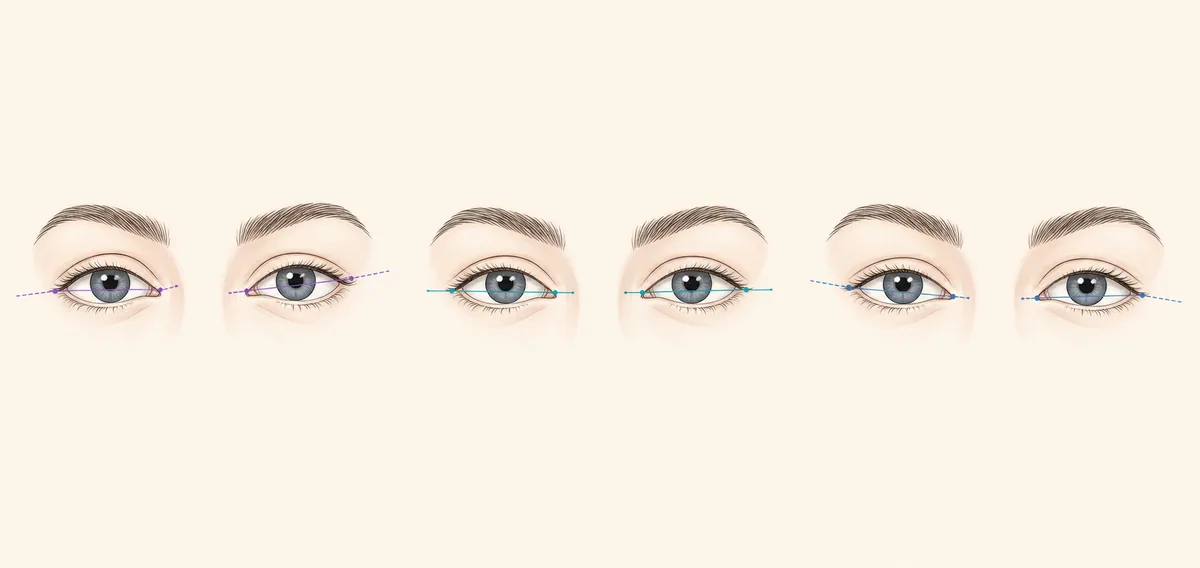
Positive canthal tilt
The outer corner is higher than the inner corner, so the line rises gently toward the temple.
Neutral canthal tilt
The two corners are close to the same height, so the line appears approximately level.
Negative canthal tilt
The outer corner is lower than the inner corner, so the line falls gently toward the temple.
Positive vs Neutral vs Negative Canthal Tilt
The categories are useful shorthand, but real faces exist on a continuous range. A tiny apparent difference can disappear when the camera or head is corrected, so describe mild results cautiously.
| Type | Corner relationship | How it may read in a level photo | What not to assume |
|---|---|---|---|
| Positive | Outer corner is higher | Upward or lifted corner direction | It does not prove a particular eye shape, age or attractiveness level. |
| Neutral | Corners are nearly level | Balanced or horizontal corner direction | Neutral does not mean featureless, average or less expressive. |
| Negative | Outer corner is lower | Downward or softer corner direction | It is not automatically a flaw, illness or sign that treatment is needed. |
| Asymmetric | Left and right angles differ | One side may look more lifted | Mild asymmetry is common; sudden change or symptoms deserve professional review. |
How to Check Canthal Tilt from a Photo
Use this as a descriptive photo exercise, not a medical measurement. The goal is to reduce perspective errors before comparing the two eye corners.
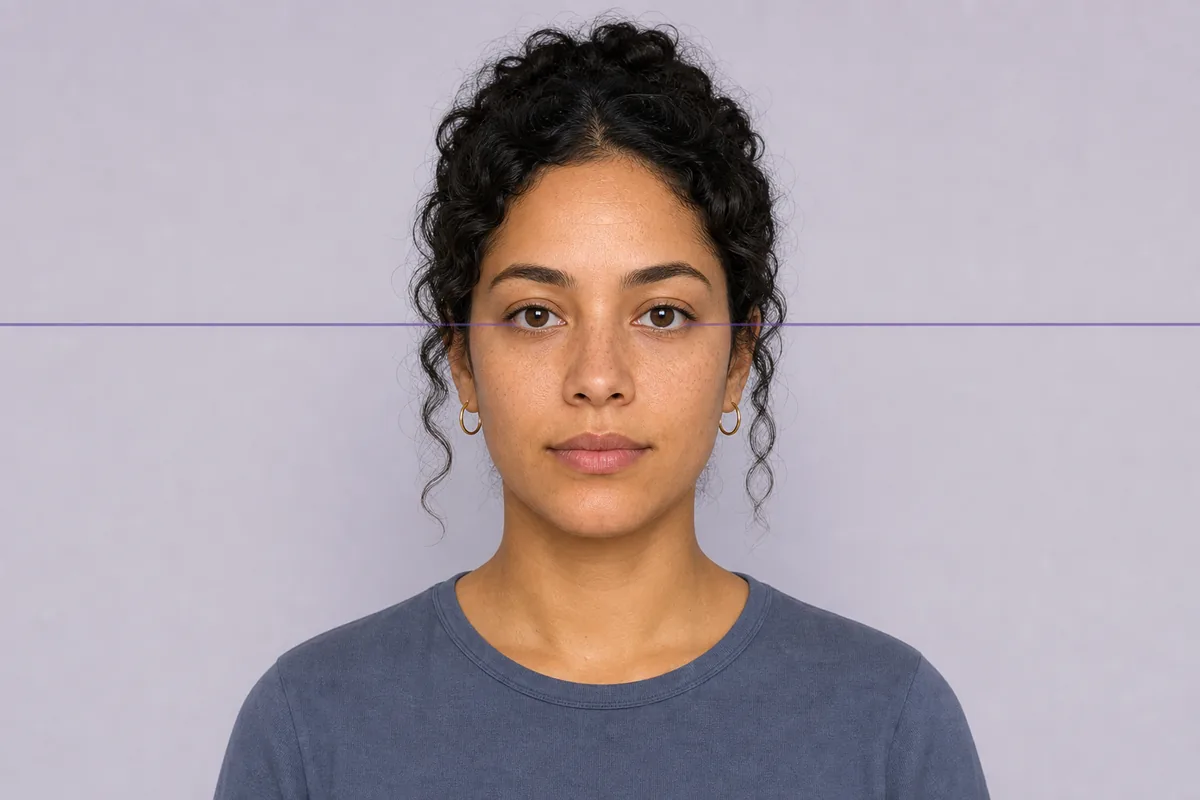
1. Choose a straight-on photo
Use a recent, unfiltered portrait in which both ears and both sides of the face appear similarly visible. A camera at eye height and a little distance away is more reliable than a close wide-angle selfie.
2. Level the head
Check that the pupils, brows and mouth are not obviously rotated as a group. Do not level the image by forcing the eye corners themselves to become horizontal; use the overall head position as the reference.
3. Relax the expression
Look toward the lens without squinting, widening the eyes or lifting one eyebrow. A smile can raise the cheek and narrow the lower lid, while a squint can change the apparent outer corner.
4. Mark the visible corners
Identify the medial canthus near the nose and lateral canthus near the temple for one eye. Ignore the end of the eyeliner, the last eyelash and the eyebrow tail.
5. Compare more than one image
Repeat the check with two or three well-matched photos. If the category changes between images, the honest conclusion is that the photo setup is driving the result or the tilt is too mild to classify confidently.
Best practical rule
Classify only a direction that repeats across level, front-facing photos. If it does not repeat, call the result uncertain rather than choosing the most flattering or least flattering frame.
Five Photo Errors That Change Apparent Eye Tilt
Canthal tilt is a small spatial relationship, so ordinary photography choices can overpower it. Check these errors before comparing yourself with an example image.
- Head roll: tilting one ear toward a shoulder raises one side of the face and lowers the other, creating false left-right differences.
- Camera height: looking up or down changes eyelid exposure and the way the outer corners sit against the cheek and brow.
- Close selfie distortion: a phone held very close exaggerates central features and makes the sides of the face recede, weakening geometric comparisons.
- Expression and blinking: squinting, smiling, eyebrow lifting or catching one eye mid-blink can shift the visible lid margins.
- Makeup, lashes and filters: winged liner, lash direction, beauty filters and face reshaping can create a corner line that is not the anatomical canthal line.
Does Canthal Tilt Determine Attractiveness?
No single eye angle determines whether a face is attractive. Some observational and aesthetic studies discuss upward palpebral-fissure inclination, but results depend on the population, measurement method, sex, age, cultural context and the rest of the face. Turning an average association into a rule for every person is not scientifically justified.
In everyday perception, the eye area is read as a whole. Outline, upper-lid exposure, brow shape, eye spacing, scleral show, symmetry, cheek support, expression and lighting interact with canthal tilt. A mild negative tilt can look harmonious on one face, while a stronger positive tilt can look less balanced on another. Neutral is also a normal, expressive result.
The healthiest use of this concept is descriptive: it can help name why an eye looks slightly upturned or downturned in a reliable photo. It should not be used to rank people, predict personality or justify extreme appearance changes. If a beauty test reports an eye-angle result, treat it as one photo-dependent estimate rather than an objective verdict.
Can Canthal Tilt Change?
Your underlying corner positions are influenced by anatomy, but the visible angle can appear different across time and photos. Swelling, fatigue, expression, contact-lens irritation and camera setup can cause temporary differences. Skin and eyelid support also change with age, and trauma, facial-nerve problems or previous eyelid surgery can affect canthal position.
Makeup can change the visual direction without changing anatomy. Eyeliner and lash styling may emphasize an upward or downward sweep, but posture exercises, facial exercises or repeatedly pulling the skin cannot be assumed to reposition the canthal tendons. Surgical procedures around the canthus are specialized medical interventions with functional risks as well as cosmetic goals; they are not a do-it-yourself response to a selfie category.
- Compare consistent photos before deciding that the angle has changed.
- Avoid diagnosing eyelid laxity or nerve problems from an online image.
- Discuss persistent functional symptoms or a sudden new asymmetry with an eye-care professional.
- For cosmetic concerns, seek a qualified ophthalmologist or oculoplastic surgeon who can evaluate eyelid closure, tear-film protection and facial anatomy.
When Is Professional Eye Care Appropriate?
A lifelong, symptom-free positive, neutral or negative tilt usually represents normal variation. A photo label alone is not a reason for treatment. Professional assessment is more appropriate when the eyelid position changed suddenly, one side became noticeably different, the lower lid pulls away from the eye, the eye no longer closes normally, or you have persistent dryness, irritation, pain, excessive tearing, double vision or changes after trauma or surgery.
These signs do not prove a serious condition, but they involve eyelid function and eye-surface protection rather than simple appearance. An optometrist or ophthalmologist can assess the eye, while an oculoplastic specialist can evaluate complex eyelid position and surgical questions. Seek urgent medical care for sudden facial weakness, a new droop accompanied by neurological symptoms, eye injury or sudden vision change.
Canthal Tilt FAQ
What is canthal tilt?
Canthal tilt is the direction of the line from the inner corner of an eye to the outer corner. An outer corner that is higher creates a positive tilt, a level relationship is neutral, and a lower outer corner creates a negative tilt.
What is a good canthal tilt?
There is no universal best angle for every face. Normal values vary across people and populations, and harmony depends on the entire eye area and face. A precise number from an unstandardized selfie should not be treated as a beauty target.
Can I measure canthal tilt accurately with a selfie?
A selfie can show a rough direction if the head is level, the camera is at eye height and the expression is relaxed. It is not a clinical measurement, and close-lens distortion or a few degrees of head rotation can change a mild result.
Is canthal tilt the same as upturned or downturned eyes?
They overlap, because corner direction helps define upturned or downturned eyes. Eye shape is broader, however, and also includes outline, eyelid crease, iris exposure, hooding and spacing.
Why is my canthal tilt different on each side?
Mild facial asymmetry is common, and head rotation, blinking or uneven brow movement can exaggerate it in photos. A sudden or symptomatic difference should be assessed by an eye-care professional.
Can exercises change negative canthal tilt?
There is no good basis for assuming facial exercises can safely reposition the structural supports of the eye corner. Exercises may change expression or muscle tension temporarily, but persistent anatomical or functional concerns require professional evaluation.
How do I measure canthal tilt from a photo?
Use a level, front-facing photo, mark the visible inner and outer corners of one eye, and compare the line between them with a horizontal reference. Repeat on the other side. Treat a mild result as approximate because head rotation, lens distortion and expression can change the apparent angle.
The Useful Way to Read Canthal Tilt
Canthal tilt simply describes whether the outer eye corner is higher, level with or lower than the inner corner. Check it only in level, front-facing, unfiltered photos and compare multiple images. Keep the result separate from eyeliner, lashes, eyebrows and the broader eye-shape category.
Most importantly, treat the angle as one normal facial feature rather than a beauty grade. Overall facial harmony and expression matter more than an isolated line. A sudden change, functional problem or persistent eye symptom belongs with an eye-care professional—not an online score.
References and Further Reading
- EyeWiki: Medial and Lateral Canthoplasty — Clinical anatomy, eyelid function, evaluation and surgical considerations for the canthi.
- PMC: Diagnostic analysis of canthal tilt — Photographic measurements and left-right canthal-tilt variation in a Korean clinical sample.
- PubMed: Ocular-region anthropometric analysis — Population-specific measurements and aesthetic evaluation of ocular-region proportions.