What Is the Most Attractive Face Shape? A Research-Based Answer
There is no universal winning shape. Here is how oval, heart, square, round, diamond and oblong faces create different impressions—and what matters more than the label.


Table of Contents
Searches for the most attractive face shape usually come from a reasonable curiosity: people want to understand how their facial outline is perceived and whether one category has an advantage. The useful answer is more nuanced than a ranking. A face is not judged as an empty oval, square or heart. People see the relationship between the outline, eyes, brows, nose, lips, skin, expression and hairstyle at the same time.
That is why two people with the same face-shape label can create completely different impressions. This guide compares the common categories, explains the findings that appear most consistently in facial-attractiveness research, and shows how to use face shape as a styling tool rather than a beauty score.
Is There One Most Attractive Face Shape?
No single face shape wins across all people, cultures and contexts. Oval faces are commonly presented as a flexible styling reference because their length and width are relatively balanced. Heart faces can emphasize the eyes and cheekbones. Square faces often communicate definition and strength. Round faces may appear soft and youthful, while diamond and oblong faces create their own distinctive proportions.
These descriptions are tendencies, not scores. The same jaw width can look harmonious on one face and visually dominant on another because forehead width, cheekbone position and feature scale differ. A natural expression, healthy presentation and a hairstyle that works with the whole face usually affect the impression more than the category name.
The practical verdict
If you need a short answer, oval is often treated as the most versatile shape—not the objectively most beautiful one. Your best-looking result comes from balance among your own features, not from trying to imitate another outline.
Face Shape Comparison: What Each Shape Emphasizes
Use this table as a visual vocabulary, not a hierarchy. Many faces sit between two categories, and camera angle or hairstyle can change the apparent outline.
| Face shape | Common visual traits | Typical impression | Important note |
|---|---|---|---|
| Oval | Face length greater than cheekbone width; softly tapered jaw | Balanced and versatile | Often called ideal because many styles fit it, not because it is universally preferred |
| Heart | Broader forehead and cheekbones with a narrower chin | Expressive and delicate or dramatic | Feature scale determines whether the upper face feels balanced |
| Square | Similar forehead, cheekbone and jaw widths with an angular jaw | Defined and strong | Soft expression and styling can completely change the mood |
| Round | Similar face length and width with softer curves | Soft, open and youthful | Round does not mean lacking structure; cheekbones can still be prominent |
| Diamond | Cheekbones wider than forehead and jaw with a narrow chin | Sculpted and distinctive | Often overlaps with heart or oval categories |
| Oblong | Face noticeably longer than wide with straighter sides | Elegant and elongated | Camera distance strongly affects how long the face appears |
| Triangle | Jaw wider than cheekbones or forehead | Grounded and defined | Hairline and jaw angle help distinguish it from square |
What Facial Attractiveness Research Actually Finds
Research reviews more often discuss averageness, symmetry, sexual dimorphism, skin appearance and the interaction among features than a single preferred face outline. In this context, averageness does not mean plain. It means that the relative placement and scale of features are not extremely far from familiar population patterns, which may make a face easier for the visual system to process.
Symmetry also has an association with attractiveness, but perfectly mirrored faces are not a realistic target. Normal human faces contain small asymmetries, and expression can make a technically uneven image more engaging. Photo pose, lens distance and lighting can exaggerate asymmetry, so a selfie is not a clinical measurement of facial balance.
Proportion matters as a relationship. Facial thirds, width-to-height relationships and feature spacing can help describe a face, but none acts as a universal beauty formula. Even the golden ratio is better treated as an educational comparison than a pass-or-fail standard.
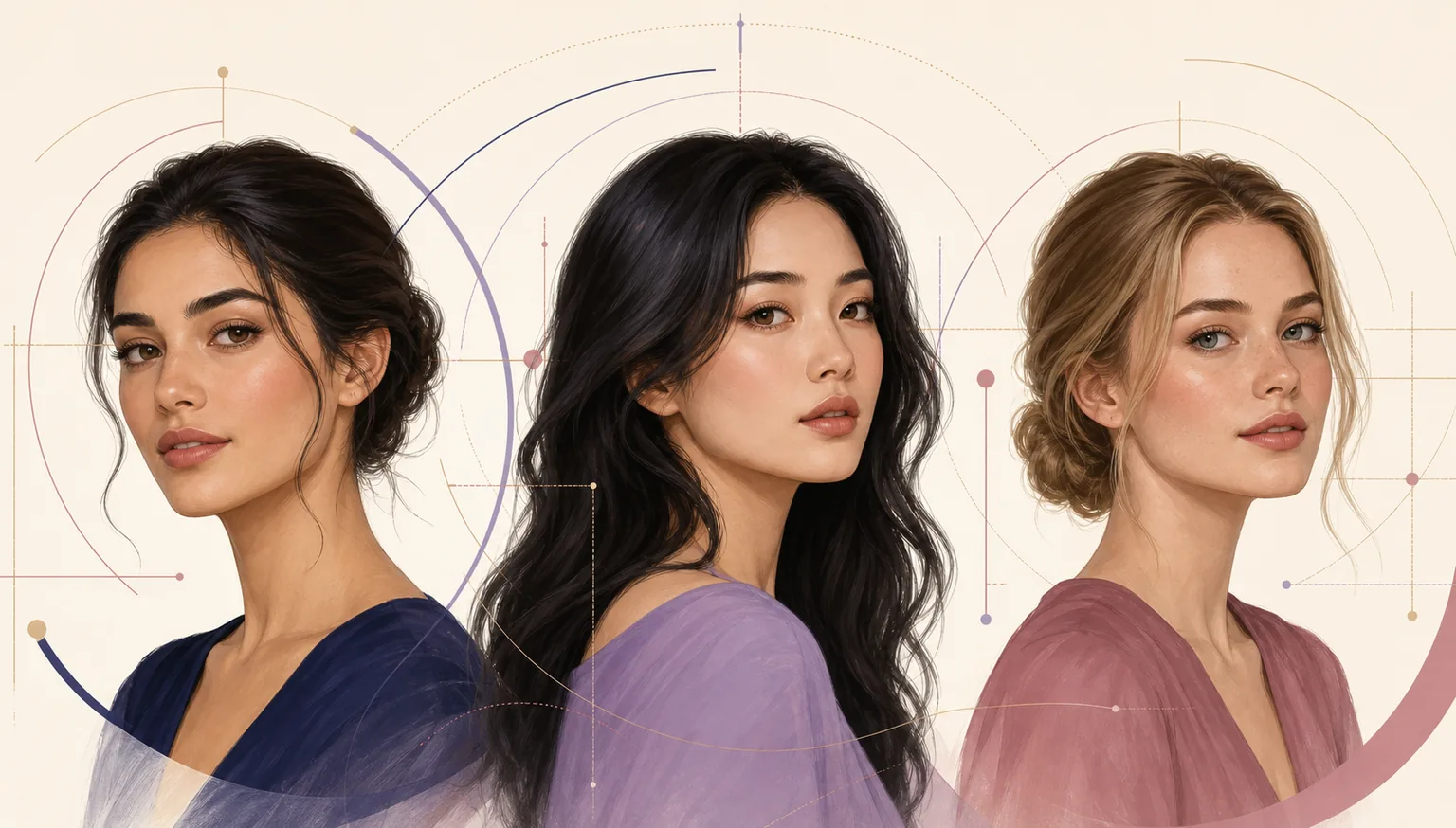
Harmony
Features feel visually related in scale and placement; no single measurement decides the result.
Averageness
Familiar population-level proportions can be processed fluently without making every attractive face look alike.
Symmetry
Broad left-right balance may help, while small natural differences remain normal and expressive.
Expression
Eye contact, warmth and a genuine expression can change perceived attractiveness more than face-shape terminology.
Gender, Culture and Personal Preference Change the Answer
Articles sometimes claim that a heart or oval face is best for women and a square face is best for men. Those claims often mix styling conventions, celebrity examples and gender stereotypes with limited evidence. A defined jaw can be attractive on any gender; a softer outline can be attractive on any gender. The impression depends on how the trait fits the rest of the face and the observer's preference.
Cultural context also matters. Media, local beauty traditions and the faces people regularly see influence which traits feel familiar or aspirational. Preferences can change over time and within the same country. This is one reason a global ranking of face shapes would be misleading.
Personal preference is not statistical noise—it is part of attraction. Some people prefer angular definition, others softness, prominent cheekbones or a longer silhouette. A useful guide can describe these impressions, but it should not turn them into a verdict about a person's worth.
How to Identify Your Face Shape More Reliably
If your goal is styling, start with a neutral front-facing photo and compare relationships rather than tracing one perfect outline.
1. Use a neutral photo
Face the camera at eye level with hair pulled away from the forehead and jaw. Avoid a very close wide-angle selfie because it can enlarge the center of the face.
2. Compare four widths
Look at forehead, cheekbone and jaw widths, then compare them with overall face length. Exact millimeters are less useful than the pattern among measurements.
3. Check the jaw and hairline
A rounded, tapered, broad or angular jaw helps separate similar categories. Hairline shape can support the conclusion but should not decide it alone.
4. Allow a mixed result
Oval-heart, round-square and oblong-oval combinations are common. Choose the two closest labels if one category does not describe the whole face.
How to Use Face Shape Without Chasing an Ideal
The best styling goal is usually balance or emphasis, not correction. Decide what you want to highlight, then test changes in ordinary lighting before making a permanent choice.
- Hair: Volume near the temples, cheekbones or jaw changes the apparent outline. Use it to emphasize a favorite feature rather than hide your face.
- Glasses: Frame scale and brow alignment often matter more than the rule that angular frames must oppose round faces.
- Facial hair: Length and density can visually widen, narrow or lengthen the lower face, so compare the result from the front and three-quarter view.
- Photos: Use moderate camera distance, even light and a natural expression. Those choices reduce distortion and make comparisons more useful.
If an app or beauty score makes you feel worse about a normal feature, step back from the number. Face-shape tools are best used for exploration and styling—not as proof that one person is more valuable than another.
Frequently Asked Questions
Is an oval face the most attractive face shape?
Oval is often described as versatile because its proportions work with many hairstyles and frames. That does not prove it is universally the most attractive. Harmony among features and individual preference matter more.
What face shape is considered most attractive for women?
Heart and oval are commonly praised in beauty media, but there is no objective female winner. Square, round, diamond and oblong faces can all be highly attractive when their features work together.
What face shape is considered most attractive for men?
Square and oval faces are often highlighted in men's styling guides, especially when the jaw is defined. This is a cultural pattern rather than a universal rule, and softer or longer shapes can be equally attractive.
Can hairstyle or weight change my face shape?
They can change the apparent outline. Hair volume, facial hair and changes in facial fullness may shift which category looks closest, while the underlying bone structure changes far less.
How accurate is an online face shape test?
It can be a useful starting point if the photo is front-facing and undistorted. Treat the result as an estimate, especially when your face combines traits from two categories.
Research and Further Reading
- Facial attractiveness: evolutionary based research — Review of averageness, symmetry, sexual dimorphism and related factors.
- New perspectives on facial attractiveness — Review discussing how multiple facial cues and social perception interact.