Face Shapes for Men: How to Find Yours and Choose Better Styles
A practical guide to measuring your outline, recognizing eight common patterns, and choosing hair, beard, and glasses ideas without treating one shape as the winner.


On this page
Face shapes for men are easier to identify when you compare proportions instead of trusting a single selfie or a hairstyle. The useful question is not which face shape is best; it is which outline you have and which styling choices create the balance you want.
This guide covers the four measurements that matter most, eight common men's face shapes, and practical directions for hair, beards, and glasses. If you want a result from your own measurements, you can use the site's face shape test after reading the method below.
What should you look for first?
Start with face length, then compare the widest part of the forehead, cheekbones, and jaw. A square face tends to look broad and angular, a round face tends to look shorter and softer, an oblong face looks longer, and an oval face usually sits between those extremes.
The result is often mixed. Hair volume, facial hair, weight change, camera distance, expression, and head tilt can all alter the outline you see. Treat the label as a styling shorthand, not as a permanent identity or a beauty score.
Best starting rule
Measure once, repeat the check with a level front-facing photo, and choose style adjustments that balance your own proportions. There is no objectively best or worst face shape for men.
How to measure your face shape at home
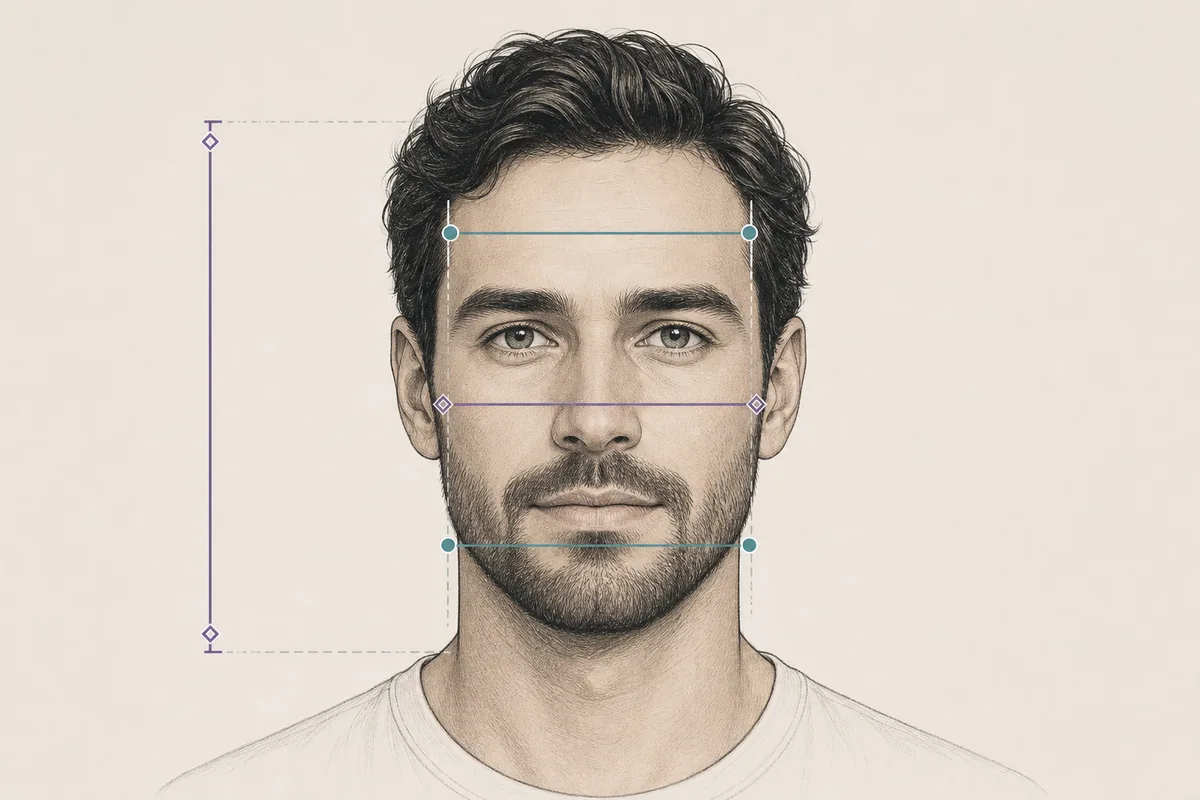
Use a straight-on photo with your head level, hair pulled away from the hairline, and a neutral expression. You do not need perfect millimeter accuracy; consistent comparisons are more useful than false precision.
1. Check face length
Measure from the center of the hairline to the bottom of the chin. If the hairline is difficult to see, use a clear front-facing photo and mark the estimated starting point consistently.
2. Compare forehead and cheekbones
Measure the widest horizontal line across the forehead and the widest line across the cheekbones. The cheekbones are often the broadest area in diamond faces, while the forehead can dominate in heart-shaped faces.
3. Estimate jaw width and shape
Compare the width around the jaw and look at the angle from the ears toward the chin. A strong squared corner, a soft curve, or a narrow pointed chin can change the final classification.
4. Look for the overall pattern
Write down the four observations and compare them as a group. If two patterns seem equally plausible, use a mixed label and test which hairstyle or frame shape gives you the result you prefer.
Eight common face shapes for men
These categories describe broad outlines, not strict boxes. The visual clues below are more helpful when you compare several features at once.
Oval
Look for: The face is longer than it is wide, with gently curved cheeks and a jaw that is softer than the forehead.
Style direction: Most styles can work. Keep enough structure in the haircut or beard to show the natural balance instead of hiding it under excessive length.
Square
Look for: Face length and width are relatively close, with a broad forehead and a defined, angular jaw.
Style direction: Texture, tapering, or a slightly softer beard line can add movement. Very sharp angles everywhere may make the outline look harder than intended.
Round
Look for: The face is close to equal in length and width, with fuller cheeks and a less angular jawline.
Style direction: Height on top, cleaner sides, and a beard with a little length at the chin can create a longer visual line. Avoid assuming that every round face needs extreme contrast.
Oblong
Look for: The face is noticeably longer, while the forehead, cheekbones, and jaw remain relatively similar in width.
Style direction: Moderate side fullness and controlled height often help. Excessively tall hair can make the face look longer, while a balanced beard can add useful width.
Heart
Look for: The forehead or cheekbones are wider and the chin narrows toward the bottom of the face.
Style direction: Texture around the sides and a fuller lower beard can visually support the chin. Avoid treating a narrow chin as a flaw; it is simply a proportion to balance.
Diamond
Look for: The cheekbones are the widest point, with a narrower forehead and jaw that taper toward the chin.
Style direction: Soft texture at the forehead and a controlled beard can keep the cheekbones from looking overly sharp. Frames with gentle curves may also work well.
Rectangle
Look for: The face is long but also angular, with a straighter forehead, cheek area, and jawline.
Style direction: Side volume, a lower profile, and a beard shape that does not add unnecessary length can make the outline feel more proportional.
Triangle
Look for: The jaw is wider than the forehead, creating a stronger lower-face emphasis.
Style direction: Texture or volume near the temples can balance the upper face. Keep the beard line clean if extra density at the jaw makes the lower half feel too heavy.
How to choose hair, beards, and glasses
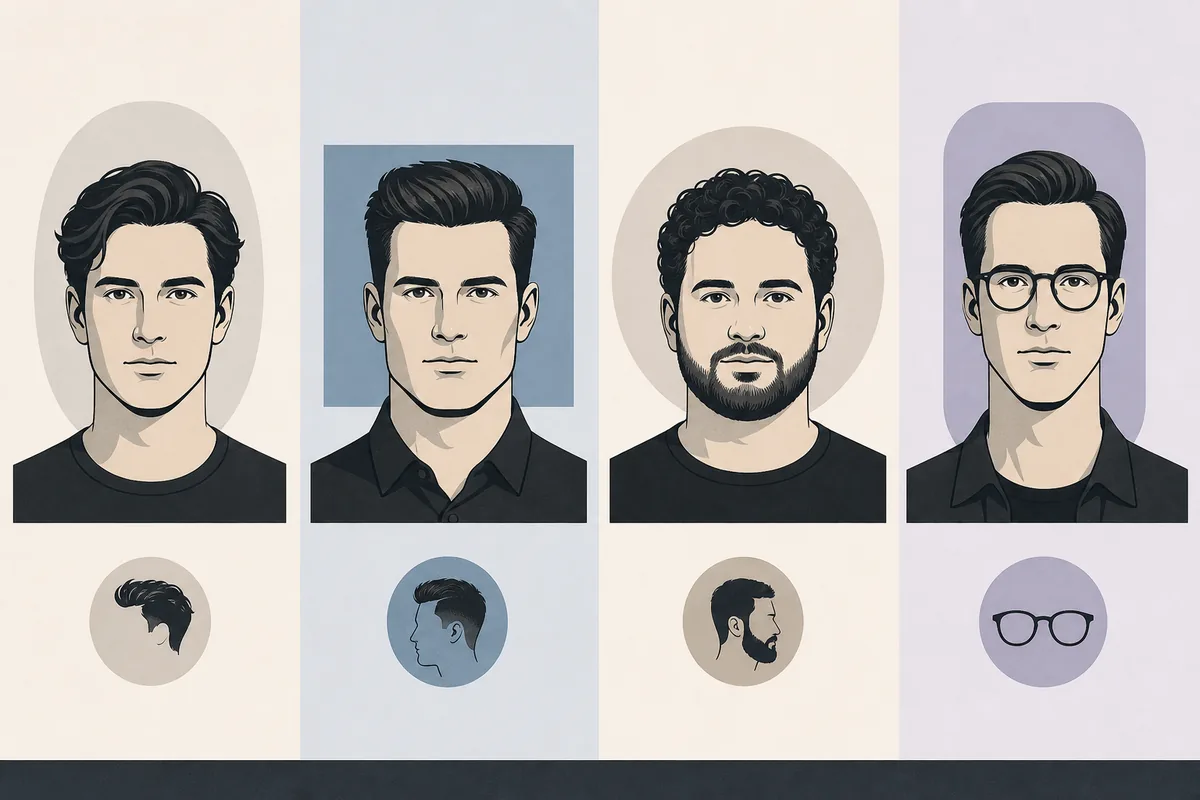
A face-shape guide should give you options, not a rigid rulebook. Start with the feature you want to balance, then change one variable at a time so you can tell what actually helps.
| Face shape | Hair direction | Beard direction | Glasses direction |
|---|---|---|---|
| Oval | Keep natural balance and texture. | Use structure without hiding the jaw. | Most proportions can work; check fit first. |
| Square | Add texture or a softer taper. | Soften very sharp corners if desired. | Rounded or gently curved frames can add contrast. |
| Round | Add moderate height and cleaner sides. | Keep a little length toward the chin. | Defined or rectangular frames can add structure. |
| Oblong | Avoid excessive height; keep some side width. | Use width without adding much chin length. | Deeper frames can interrupt a long vertical line. |
| Heart | Add texture near the sides or forehead. | Support the narrower chin with controlled fullness. | Balanced frames can keep the upper face from dominating. |
| Diamond | Soften the forehead with movement. | Keep the jaw line controlled and natural. | Curved or lighter frames can balance wide cheekbones. |
| Rectangle | Use side fullness and a lower profile. | Do not add unnecessary length. | Medium-depth frames can break up vertical length. |
| Triangle | Create some volume near the temples. | Keep extra jaw density under control. | Frames with a stronger upper line can balance the face. |
Hair first
Use height to lengthen a shorter outline, side texture to soften a strong jaw, or moderate side volume to keep a longer face from looking narrow. Hair texture and maintenance should decide the final cut more than a category label.
Beard second
Beard shape can change the apparent jawline quickly. More length at the chin can lengthen a round outline, while a wider and shorter shape can support an oblong or heart-shaped outline.
Glasses last
Try a frame that contrasts with the dominant angles: softer curves can balance a square or diamond outline, while a more defined frame can give a round face additional structure. Fit and comfort still matter most.
What face-shape advice cannot tell you
Face shape is a broad visual description, not a clinical measurement and not a reliable way to rank attractiveness. Two men can share an oval or square outline and still look completely different because their features, expressions, hair, and proportions differ.
Photos also introduce distortion. A close phone lens, a tilted head, uneven lighting, or hair covering the forehead can make the face look wider, longer, or less symmetrical than it is. Repeat the measurement with a neutral, level image before changing your style.
If your outline does not fit one category, mixed results are normal. The goal is to learn which choices make your features feel intentional, not to force yourself into a single label.
Face shapes for men FAQ
Is there a best face shape for men?
No. Oval, square, round, oblong, heart, diamond, rectangle, and triangle outlines can all look distinctive. The useful question is which haircut, beard, or frame helps you express the proportions and style you prefer.
What is the easiest way to find my face shape?
Use a level front-facing photo, compare face length with forehead, cheekbone, and jaw width, and then look at the jaw angle and chin. If two categories seem close, record a mixed result instead of forcing a single answer.
Which glasses suit my face shape?
Start with comfort, bridge fit, and the size of the frame. As a styling shortcut, contrast often helps: softer frames can balance angular faces, while a more defined frame can give a rounder outline structure. Try several shapes in the correct width.
Can a man's face shape change?
The underlying bone structure does not change quickly, but the visible outline can change with age, weight, facial hair, hairstyle, expression, and camera angle. That is why a face-shape label should stay flexible.
Should I use a face shape test or judge from a photo?
A measurement-based face shape test can give you a repeatable starting point, while a photo helps you see how hair, beard, and lighting affect the outline. Using both is more useful than trusting a single close selfie.