Facial Harmony Test: What It Measures and How to Read a Score
A practical guide to symmetry, facial thirds, feature balance, photo quality and the limits of an online harmony score.

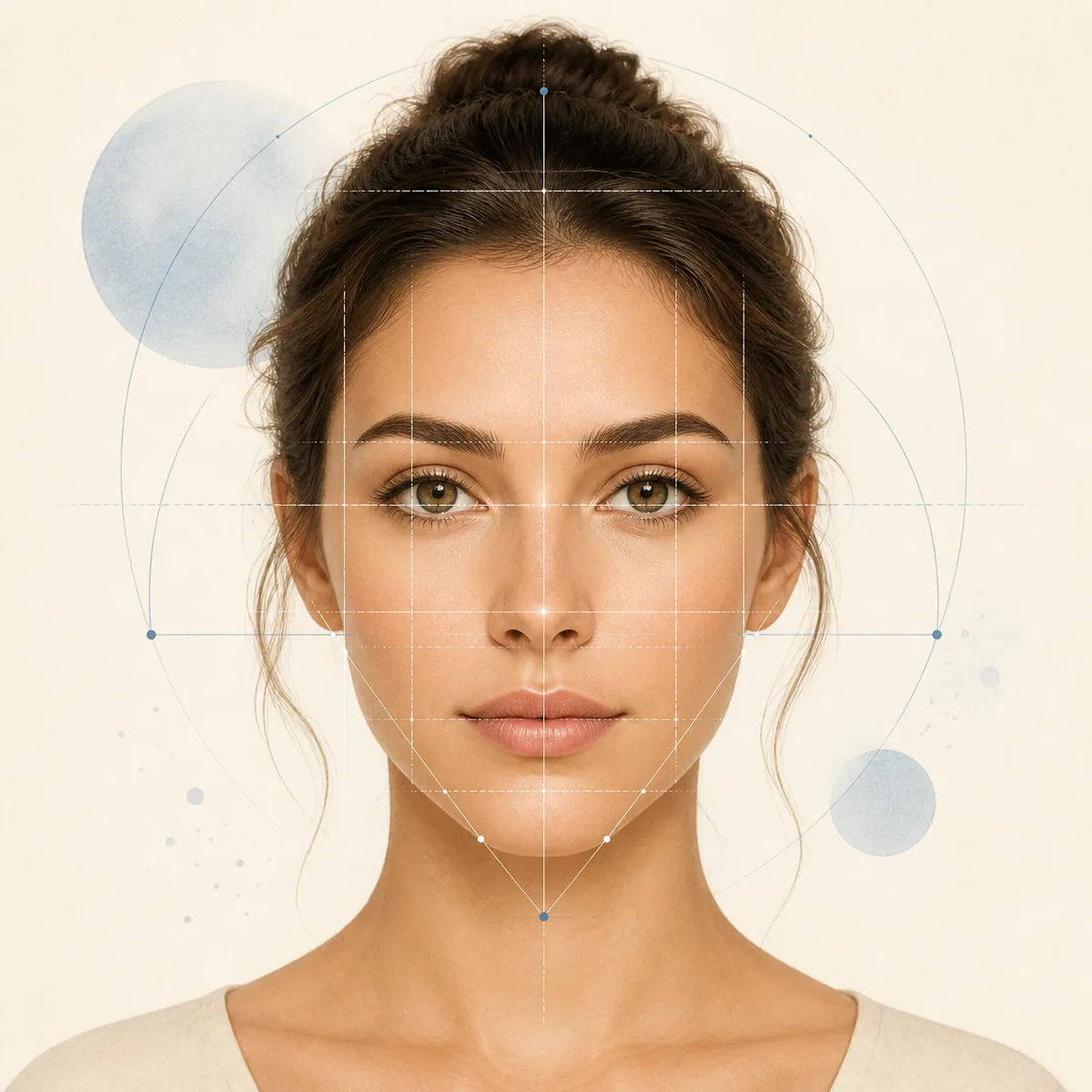
Table of Contents
People searching for a facial harmony test are often trying to answer a reasonable question: why can one face look balanced in a calm portrait but different in a selfie, mirror or video call? The answer is that visual harmony is not one measurement. It is the combined impression created by structure, spacing, expression, light, camera distance and the way a person presents themselves.
An online facial harmony test can still be useful when it is treated as a structured observation. It can help you describe patterns, compare two consistent photos and decide whether you want to explore facial thirds, symmetry or feature spacing in more detail. It becomes misleading when a single score is presented as permanent, scientific or more important than the person behind the image.
What Is a Facial Harmony Test?
A facial harmony test is a visual analysis that combines multiple facial signals instead of looking at one isolated feature. Depending on the tool, it may compare the approximate balance between the left and right sides, the upper-middle-lower facial thirds, the spacing of the eyes and brows, the relationship between the nose, lips and chin, and the quality of the reference photo.
The word harmony describes how parts relate to one another. It does not mean that every distance must match a fixed ideal. Faces have normal variation, and many memorable or attractive faces are distinctive precisely because they do not follow a perfectly average template. A useful test should therefore explain what it observed and how reliable the photo was, not just show a large number.
This is also why a facial harmony test is different from a clinical facial assessment. A browser-based result can describe an image; it cannot diagnose a condition, predict health, measure personality or determine how other people will respond to you. If a concern involves pain, breathing, vision, jaw function or a sudden physical change, a qualified clinician is the right source of advice.
The useful definition
Think of facial harmony as a multi-signal description: how proportions, spacing, symmetry and presentation work together in one image. Use the result to ask better questions, not to assign a permanent value to your appearance.
Which Signals Does a Facial Harmony Test Combine?
The strongest interpretation comes from several modest clues that point in the same direction. Each clue has limits, so a responsible test keeps the categories separate before combining them into a plain-language summary.
Facial symmetry
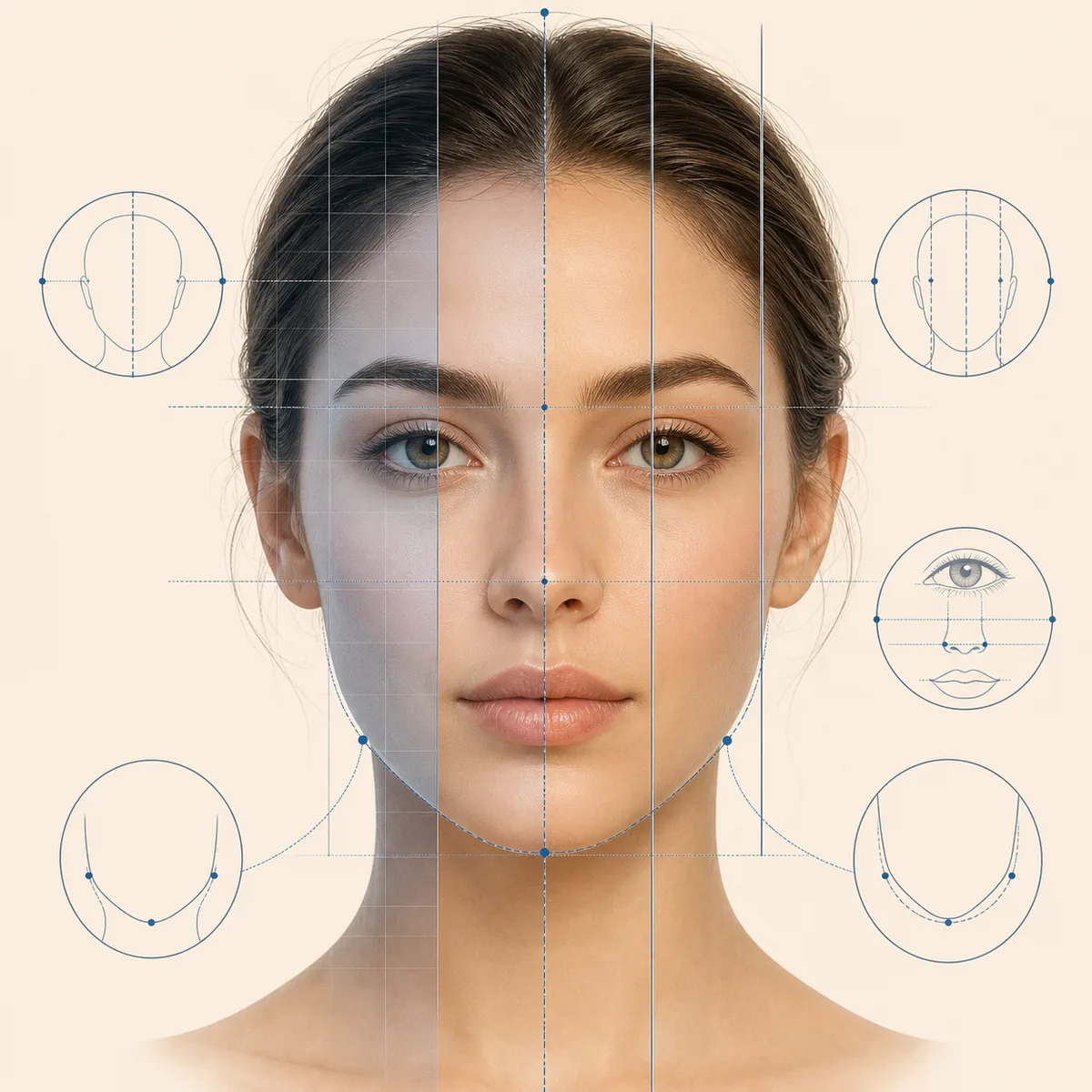
A front-facing image can be compared across a center line to describe broad left-right differences. Small asymmetries are common and can come from normal anatomy, expression, head rotation or uneven lighting. Symmetry is one signal, not the whole face.
Facial thirds and proportions
The upper section from hairline to brows, middle section from brows to the nose base and lower section from nose base to chin give a simple vertical map. A result near 1:1:1 is a reference point, not a rule that every face must satisfy.
Feature balance and spacing
The relationship between eyes, brows, nose, lips, jaw and chin affects the overall reading. The question is not whether one feature is universally ideal; it is whether the features appear to belong to the same visual composition at the same angle.
Photo quality and presentation
Camera distance, lens distortion, light direction, facial expression, hair, glasses and makeup can change the apparent balance. A low-quality or heavily angled photo should lower confidence in the result rather than be treated as a precise measurement.
How to Do a Fair Facial Harmony Check at Home
You do not need a perfect studio portrait. You do need a repeatable reference. If the photo changes dramatically between attempts, the score may be measuring the setup more than the face.

1. Use a neutral front-facing photo
Place the camera near eye height, keep the head upright and look straight ahead. Leave a little distance between the camera and your face instead of using a very close wide-angle selfie. Keep the same crop if you plan to compare two images.
2. Choose even, soft lighting
Face a window or use a broad light source so one side is not much darker than the other. Strong side light can create shadows that look like structural asymmetry. Avoid filters, portrait blur and automatic face reshaping.
3. Relax the expression and keep styling consistent
Rest the jaw, close the mouth naturally and take note of glasses, bangs, facial hair or makeup. You can repeat the check with styling changes, but do not compare a filtered selfie with an unfiltered portrait and call the difference structural.
4. Read the pattern before the number
First ask which signals were stable and which were uncertain. If symmetry looks different after you straighten the head, or facial thirds change when the hairline is hidden, the correct conclusion is lower confidence—not that your face suddenly changed.
How to Read a Facial Harmony Score
There is no single universal facial harmony scale used by every researcher, clinician or image tool. One website may use a percentage, another may use a ten-point score, and a third may only provide descriptive labels. Those outputs are not interchangeable. A score is meaningful only inside the method that produced it.
For a practical reading, treat the score as a confidence-weighted summary. A result can be useful when the image is straight, clear and consistent and when several signals agree. It deserves caution when the photo is tilted, close, shadowed, filtered or expression-heavy. If the report does not explain its inputs, do not infer more precision than it provides.
You can also use a simple editorial scale: stable pattern, mixed pattern or low-confidence pattern. This is not a scientific grading system. It is a safer way to decide what to do next: keep the result as a description, check one proportion manually, or retake the photo before drawing a conclusion.
| Signal | What to check | Why it matters |
|---|---|---|
| Symmetry | Does the left-right reading stay similar in two level, unfiltered photos? | A stable pattern is more informative than a difference visible only under one shadow or head angle. |
| Facial thirds | Are hairline-to-brow, brow-to-nose and nose-to-chin distances being measured from clear landmarks? | Hidden hairlines and camera tilt can make a normal proportion look unusually long or short. |
| Feature spacing | Do the eyes, brows, nose, lips and chin look related at the same perspective? | Harmony is relational; isolating one feature can create an exaggerated judgment. |
| Photo quality | Is the lens distance, light, crop and expression consistent? | A poor reference lowers confidence in every downstream measurement. |
| Context | Does the result change with hairstyle, glasses, makeup or a relaxed expression? | Presentation changes the visible composition without proving that facial structure changed. |
A score is a prompt, not a verdict
If a tool gives you 72, 8.1 or “high harmony,” do not compare that number with a different website or treat it as a universal ranking. Ask what was measured, how clear the photo was and whether the same pattern appears in ordinary, unedited images.
Facial Harmony Test vs Other Face Tools
Different tools answer different questions. Choosing the narrowest useful tool prevents you from making one page or one score carry too much meaning.
- Use a facial harmony test when you want a broad explanation of how several visual signals interact.
- Use a facial thirds test or guide when your question is specifically about vertical upper, middle and lower face proportions.
- Use a face symmetry test when you want to focus on left-right balance and manual comparison rather than a beauty score.
- Use a golden ratio face calculator when you want to explore a mathematical reference, while remembering that a ratio is not a complete attractiveness model.
- Use an image-based face rating tool only as photo-specific feedback, and check its privacy policy before uploading a personal image.
- If a result is making you feel distressed or compulsive about checking, step away from repeated scoring and choose a supportive, offline conversation instead.
Frequently Asked Questions About Facial Harmony Tests
What is a facial harmony test?
It is an educational visual analysis that combines signals such as symmetry, facial thirds, feature spacing and photo quality. It describes one image; it does not establish a permanent beauty value or a medical diagnosis.
Is a facial harmony score scientific?
The word score alone does not tell you that. Different tools use different formulas, reference samples and photo assumptions. A result is more useful when the method and limitations are explained, but it should still be treated as descriptive rather than universal.
How do you score facial harmony?
Start with a level, clear and unfiltered photo, then review symmetry, facial thirds, feature spacing and image quality separately. Combine the observations only after noting uncertainty. There is no single accepted formula that turns those signals into one objective beauty number.
Is a facial harmony calculator the same as a facial thirds calculator?
No. A facial thirds calculator focuses on three vertical sections. A facial harmony calculator or test may combine thirds with symmetry, spacing and presentation. They overlap, but they answer different questions.
Why does my facial harmony score change between photos?
Camera perspective, head rotation, lighting, expression, crop, hair, glasses and filters can all change the visible relationships. A changing result usually means the reference conditions changed, not that your underlying face changed overnight.
Is facial harmony an objective measure of attractiveness?
No. Proportion and symmetry can describe part of a visual impression, but attractiveness also includes expression, movement, style, culture, familiarity and personal preference. A harmony result should never be used as a complete judgment of a person.
Sources and Further Reading
These references provide background for facial proportion research and the need to keep an image-based result within its limits.
- National Library of Medicine: facial attractiveness and symmetry research — A starting point for peer-reviewed biomedical literature; individual studies vary in methods and populations.
- National Library of Medicine: anthropometric and facial proportion research — Searchable index for research on facial measurements, proportions and clinical context.
- Am I Pretty Facial Thirds Guide — Related internal guide for measuring vertical facial thirds from a consistent front-facing image.
Last reviewed: Updated August 19, 2026