What Is the Golden Ratio Face? How to Measure Facial Proportions
A calm, practical explanation of the 1.618 idea, the measurements people compare, and why a ratio can never summarize an entire face.


In this guide
When people ask, "what is the golden ratio face?", they are usually asking whether a face can be described by a pleasing mathematical proportion. The short answer is that 1.618 can be used as a reference for selected measurements, but it is not a universal definition of beauty.
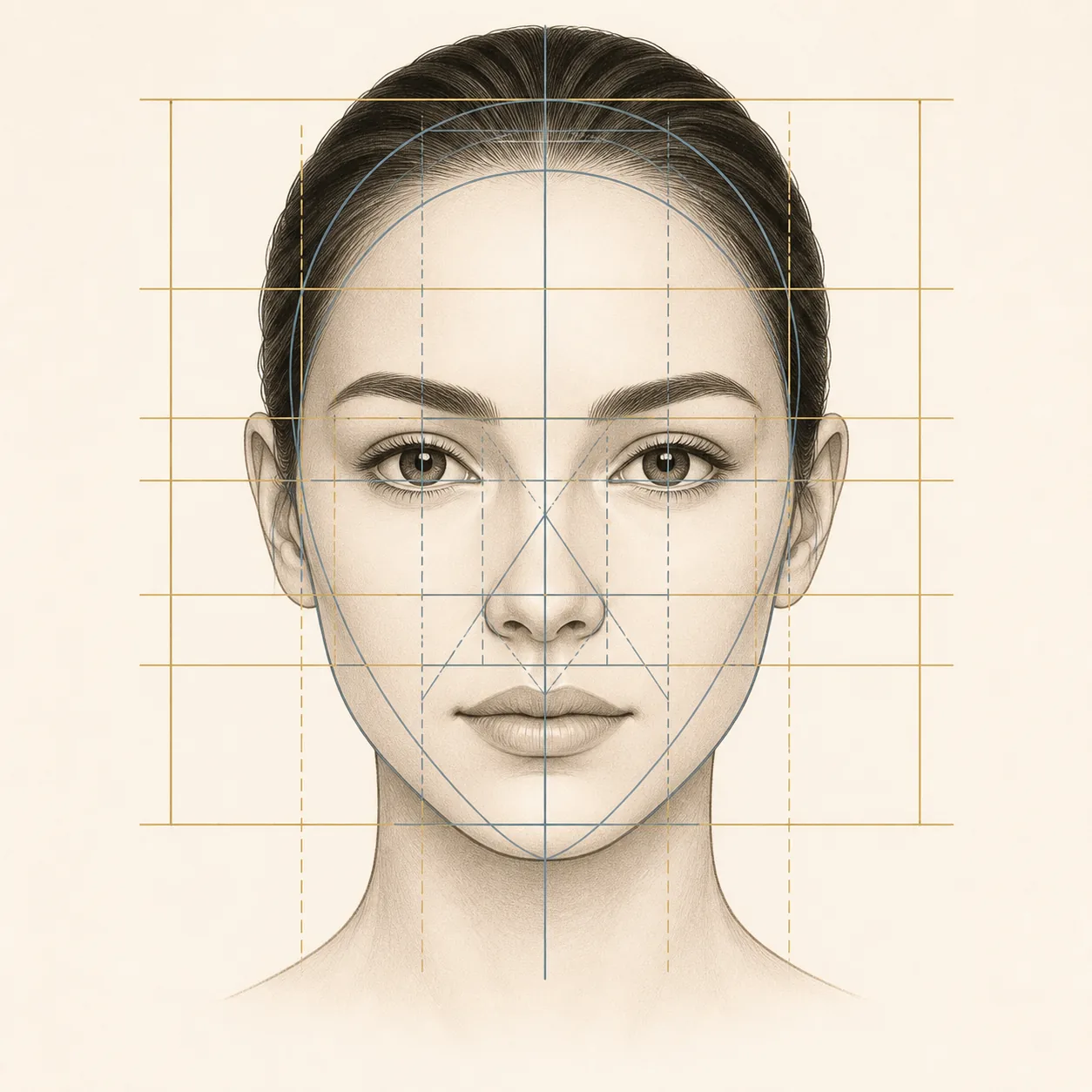
In practical terms, a golden ratio face guide compares relationships such as face length to face width, or one feature width to another. The useful part is the measuring process: a straight reference photo, consistent points, and a result that is treated as one piece of context. The misleading part is turning a single ratio into a pass-or-fail label.
What does the golden ratio face mean?
The golden ratio is commonly written as φ, or about 1.618. In geometry, it describes a relationship in which the whole is to the larger part as the larger part is to the smaller part. Beauty articles often borrow this language and apply it to facial length, width, feature spacing, or the balance between different areas of the face.
That description does not mean that a face should contain one exact number everywhere. Facial measurements are affected by the landmarks chosen, the angle of the head, the camera lens, expression, hairline, and whether the image is mirrored. Two careful measurements of the same person can differ because the reference points were placed differently.
Research on facial attractiveness also discusses several influences at once, including averageness, symmetry, proportions, expression, skin, and cultural context. A golden ratio face check is therefore best understood as a structured proportion exercise. It can help you see how measurements relate to each other, but it cannot tell you whether a person is beautiful, healthy, or objectively better-looking.
The useful boundary
Use 1.618 to ask a narrow question—how close is this selected ratio to a mathematical reference?—not a broad question such as whether an entire face is attractive.
How to measure the golden ratio of your face
You do not need an expensive camera or a complicated app. A straight front-view portrait, a ruler, and the same unit for every measurement are enough for a repeatable personal check. Do not measure from a close selfie if you can avoid it; wide-angle distortion can make the center of the face look larger and the sides look smaller.
1. Choose a neutral reference
Use a straight front-facing portrait with the camera near eye level, relaxed facial muscles, and even light. Keep the head upright rather than tilted or turned.
2. Mark the outer landmarks
Record face length from the hairline area to the bottom of the chin, then measure the widest face area. If the hairline is unclear, note that your face-length value is an estimate rather than an exact fact.
3. Measure the main width points
Measure forehead width at its broadest visible point, cheekbone width at the widest points, and jaw width across the lower face. Write down where each measurement begins and ends so you can repeat it.
4. Keep the unit consistent
Centimeters, millimeters, and inches can all work. The unit matters less than consistency. Do not mix centimeters for face length with inches for cheekbone width.
5. Compare ratios, not isolated numbers
Divide the larger value by the smaller value only when the comparison is meaningful. For example, face length divided by face width creates one ratio; it does not describe every feature or produce a universal attractiveness score.
Which facial proportions are commonly compared?
Different websites use different formulas. The table below describes common comparison ideas without implying that every face should match them. If you use the site's calculator, enter the same-unit measurements and read the score as directional feedback.
| Comparison | What is measured | How to read it |
|---|---|---|
| Face length ÷ face width | Overall vertical length compared with the widest horizontal span | A broad outline and a long outline can produce different values; neither is automatically better. |
| Forehead, cheekbone, and jaw widths | The relative width of the upper, middle, and lower outline | This helps describe face shape and balance, but a mixed result is common. |
| Feature spacing | Selected distances such as eye spacing or nose and mouth width | Small landmark changes can move the result, so repeatability matters more than a perfect decimal. |
| Facial thirds | Upper, middle, and lower vertical sections | Facial thirds are a related proportion framework, not the same calculation as the golden ratio. |
Golden ratio face vs facial thirds and symmetry
These concepts are often mixed together because they all use the language of balance. They answer different questions, so separating them prevents overinterpretation.

Golden ratio
Compares selected length and width relationships with a mathematical reference near 1.618. It is a ratio model, not a complete facial analysis.
Facial thirds
Divides the face vertically into upper, middle, and lower sections. The sections do not have to be identical for a face to look harmonious.
Facial symmetry
Looks at left-right balance. Natural faces are not perfectly symmetrical, and a photo angle can exaggerate small differences.
Facial harmony
Considers how features work together with expression, skin, styling, lighting, and cultural expectations. It is broader than any one formula.
How should you interpret a golden ratio face result?
A result close to 1.618 simply means the selected measurements are close to that reference. It does not prove that the measurement landmarks were chosen perfectly, and it does not predict how other people will respond to a face. A result farther away is equally limited: it only says that the selected comparison differs from the model.
The most useful interpretation is to look for patterns that help you make a better next decision. If your numbers change dramatically between two photos, the camera angle or landmark placement may be the real issue. If the values are stable, you can use them as a neutral description of proportions when choosing glasses, hair framing, makeup placement, or a photo angle.
If you want a more structured manual calculation, the site's Golden Ratio Face Calculator accepts the measurements near the top of its tool page. If you want to understand vertical sections, use the Facial Thirds Guide. Neither page turns a proportion into a fixed label.
A healthier way to use the number
Treat the result like a measuring note: useful for curiosity and comparison, but too narrow to become a verdict about your appearance or self-worth.
Common golden ratio face measurement mistakes
Most surprising results come from the reference image or the landmarks, not from a mysterious change in facial structure. Check these issues before comparing two scores.
| Mistake | What it changes | Better approach |
|---|---|---|
| Using a close selfie | The lens can enlarge the center and compress the sides. | Use a more distant, level front-view portrait. |
| Tilting or turning the head | One side becomes visually shorter or wider. | Keep the nose and chin on the centerline. |
| Changing the landmark definition | A different hairline, jaw corner, or cheekbone point changes the ratio. | Write down the same endpoints and repeat them. |
| Mixing units | The ratio becomes meaningless even if each number looks plausible. | Use centimeters, millimeters, or inches consistently. |
| Comparing edited images | Filters, mirroring, and perspective changes can alter the apparent outline. | Compare unedited images with similar distance and lighting. |
Choose the right next step
The best page depends on the question you actually have. Keep the guide for explanation, then move to a focused tool or related topic only when it matches your intent.
- Golden Ratio Face Calculator — Enter manual measurements and receive a directional ratio comparison.
- Facial Thirds Guide — Learn how to compare the upper, middle, and lower vertical sections of the face.
- Face Symmetry Test — Check left-right balance with a private, measurement-based tool.
- How Pretty Am I Scientifically? — Read a broader explanation of what facial science and AI can and cannot measure.
Golden Ratio Face FAQ
What is the golden ratio face?
It is a popular way to compare selected facial measurements with the mathematical reference 1.618. It is not a universal definition of beauty and does not summarize a whole face.
What number is the golden ratio for a face?
The reference is usually written as φ and approximated as 1.618. Different articles use different landmarks and formulas, so there is no single official face score that applies to everyone.
How do I measure the golden ratio of my face?
Use a straight front-view portrait, keep your head level, measure face length and width with the same unit, and divide the selected larger measurement by the smaller one. Repeat the measurement using the same landmarks before drawing a conclusion.
Does matching the golden ratio mean I am more attractive?
No. A close ratio only means that the selected measurements are near the model. Attractiveness is influenced by many factors, including expression, feature relationships, skin, styling, culture, and personal preference.
Is this the same as a golden ratio face calculator?
This guide explains the idea and the measuring process. The Golden Ratio Face Calculator is the focused tool for entering manual measurements and viewing a directional result.
Why does my result change between photos?
Camera distance, lens perspective, head angle, expression, mirroring, and landmark placement can all change visible proportions. Use similar unedited front-view references when you retest.
How is the golden ratio different from facial thirds?
The golden ratio compares selected relationships with 1.618. Facial thirds compare three vertical sections of the face. They overlap as proportion ideas but are not the same calculation.
Further reading
These research links provide context for facial proportions and the limits of single-formula beauty claims. They are not used to assign a personal attractiveness score.
- New golden ratios for facial beauty — Research discussion of facial ratios and why proposed golden-ratio measurements should be interpreted carefully.
- Facial attractiveness: evolutionary based research — Review of multiple influences on facial attractiveness, including averageness and symmetry.
- The golden ratio and facial aesthetics: a review — A newer review of the relationship between the golden ratio and facial aesthetics.
Updated August 22, 2026