Face Height-to-Width Ratio: How to Measure Facial Index
A practical guide to the measurement, formula, interpretation, and limits of one facial proportion.

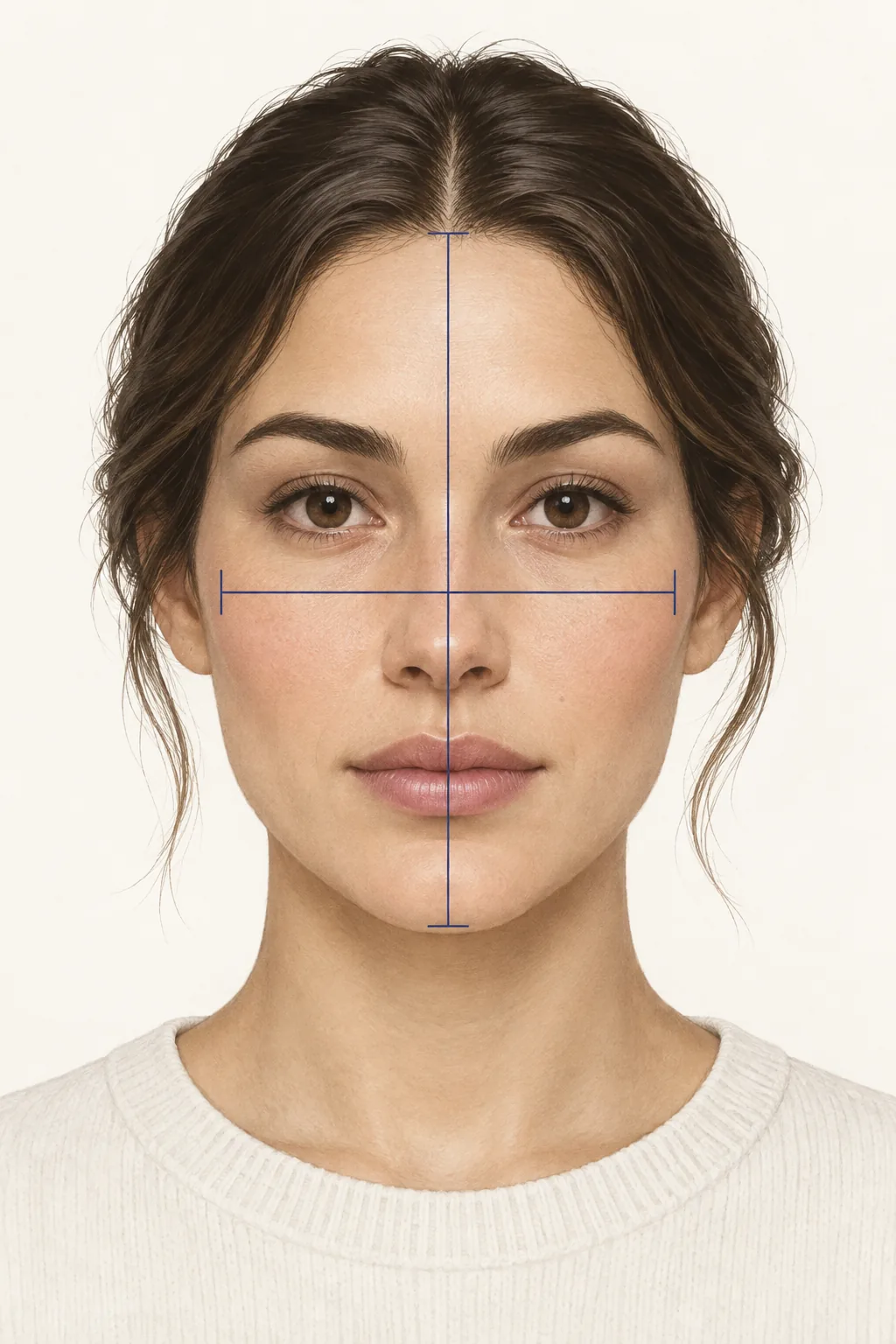
Table of Contents
If you searched for a face height-to-width ratio, you probably want a concrete way to describe whether a face looks longer, broader, or somewhere in between. Facial index gives you that starting point. It turns two visible dimensions into a repeatable comparison instead of relying on a vague impression from a mirror or selfie. The useful question is not whether your number is “good.” It is whether you measured consistently, understand what the ratio describes, and avoid treating one proportion as a complete attractiveness score.
What Is the Face Height-to-Width Ratio?
The face height-to-width ratio compares a vertical facial height with a horizontal facial width. In a simple front-view check, height is measured from the upper facial landmark near the hairline or brow region to the bottom of the chin, while width is often measured across the widest part of the cheekbones. The exact landmarks vary by method, so a result is meaningful only when you state how it was measured.
You may also see the term facial index. In anthropometric work, facial index commonly means facial height divided by bizygomatic breadth, then multiplied by 100 when it is reported as an index. Beauty blogs and calculators sometimes reverse the direction and report width divided by height instead. Those two numbers answer related but opposite questions, so always check the formula before comparing results.
A higher height-to-width value generally describes a relatively longer or narrower face; a lower value generally describes a relatively shorter or broader face. That is a geometric description, not a ranking. Two people can have similar ratios while looking very different because eye spacing, nose projection, jaw shape, cheekbone position, skin texture, hair, and expression change the overall impression.
Keep the ratio in context
- Use one measurement direction consistently: height divided by width, or width divided by height.
- Write down the landmarks and photo conditions so a second measurement can be compared fairly.
- A ratio describes face shape and proportion; it does not prove that one face is more attractive than another.
- Small changes in head tilt, lens distance, hairstyle, and chin position can move the apparent result.
How to Measure Facial Index From a Photo
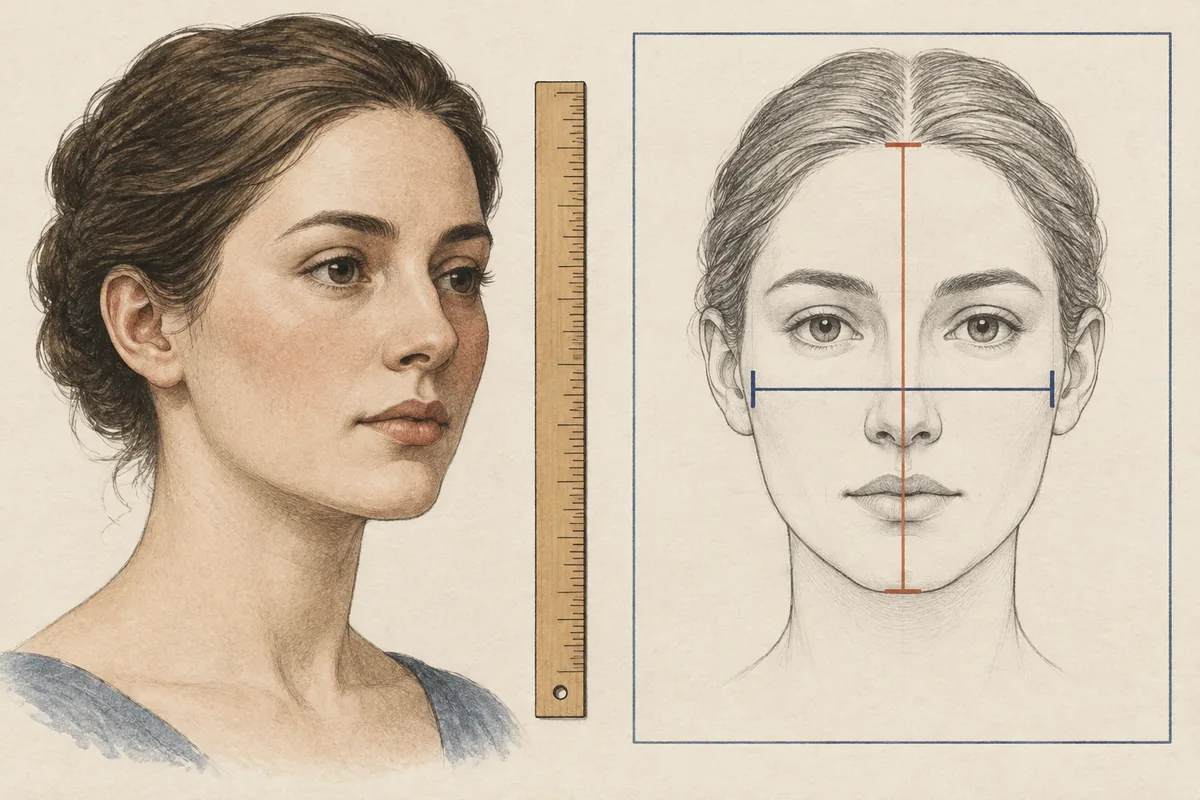
A useful measurement needs a reasonably neutral image. You do not need studio equipment, but you do need a level head, a visible facial outline, and landmarks that can be identified without guessing. Measure twice and use the same method both times.
1. Choose a neutral front view
Use a photo with the camera near eye level, the head upright, the mouth relaxed, and the face centered. Avoid a close wide-angle selfie because the nose and central face can appear larger while the sides of the face appear narrower.
2. Choose your height landmarks
For a full facial-height estimate, use the visible hairline to the lowest point of the chin. If the hairline is hidden or irregular, use a clearly stated alternative such as brow line to chin, but do not compare that result with a hairline-to-chin measurement.
3. Measure the widest facial width
Measure across the widest cheekbone region, often described as bizygomatic breadth. Keep the line horizontal and avoid measuring from hair or soft cheek tissue that does not represent the same landmark on both sides.
4. Repeat before interpreting
Write the two values down, repeat the measurement once, and compare the difference. If the second result changes a lot, fix the photo or landmarks before drawing a conclusion about facial proportions.
Face Height-to-Width Ratio Formula
The basic formula is intentionally simple. The difficult part is not division; it is selecting comparable landmarks and keeping the measurement direction clear.
Basic formula
face height-to-width ratio = facial height ÷ facial width
If you multiply the result by 100, you are reporting an index rather than a decimal ratio. A width-to-height calculator reverses the order, so its values cannot be compared directly without conversion.
Worked example
Suppose a consistent front-view measurement gives a facial height of 190 pixels and a cheekbone width of 140 pixels. Divide 190 by 140 to get about 1.36. If the same dimensions are reported as an index, multiply by 100 to get about 136. The number is only meaningful together with the chosen landmarks and image setup.
| Measurement | Example value | What it represents |
|---|---|---|
| Facial height | 190 px | The selected vertical distance between the stated upper landmark and chin. |
| Cheekbone width | 140 px | The selected horizontal distance across the widest cheekbone landmarks. |
| Height ÷ width | 1.36 | A decimal ratio describing height relative to width. |
| Facial index | 136 | The same result multiplied by 100 for index-style reporting. |
How to Read the Result Without Overreading It
There is no universal “perfect” face height-to-width ratio that can grade every person. Use the result as a description, then combine it with other observations and the purpose of the check.
Higher values suggest a longer vertical proportion
When height is large relative to width, the face may read as longer or narrower in a straight photograph. That description can help with face-shape styling, portrait framing, or comparing two photos, but it does not predict how a person will look in every angle.
Lower values suggest a broader vertical proportion
When height is smaller relative to width, the face may read as shorter or broader. Hair volume, beard lines, glasses, cheek fullness, and camera distance can reinforce or soften that impression without changing the underlying bones.
A decimal is not a beauty score
A ratio is a measurement output, not a 1-to-10 attractiveness rating. Treating it as a score encourages false precision and can hide the fact that different studies use different landmarks, samples, and definitions.
Use trends, not tiny differences
If two measurements differ by only a few pixels, the difference may be caused by image compression, landmark placement, expression, or perspective. Look for a stable pattern across comparable photos rather than reacting to one decimal place.
How This Ratio Differs From Other Face Measures
Face analysis uses several overlapping frameworks. They are easier to understand when you ask what each one measures instead of combining every number into a single score.
| Measure | Main question | Best use |
|---|---|---|
| Height-to-width ratio | Is the face relatively longer or broader? | Describe overall facial proportion from a consistent front view. |
| Facial thirds | How are the upper, middle, and lower sections balanced? | Study vertical landmarks such as forehead, midface, nose, and chin. |
| Facial symmetry | How closely do the left and right sides correspond? | Compare side-to-side balance while remembering that perfect symmetry is uncommon. |
| Golden ratio | How does a selected proportion compare with 1.618? | Explore a mathematical reference without treating it as a universal beauty law. |
Limits of the Facial Index
A careful measurement can still be a limited measurement. These caveats matter if you are using the ratio for self-image, styling, research reading, or a photo comparison.
Landmarks are not identical across guides
One source may measure hairline to chin, another may use nasion to gnathion, and a beauty calculator may use a simplified visible outline. The resulting numbers should not be mixed as if they were one standardized scale.
Perspective changes the apparent geometry
A camera that is too close, too high, too low, or angled sideways changes the apparent width and height. A neutral reference photo is more useful than a dramatic selfie, but even a neutral photo is still a two-dimensional projection.
A face is three-dimensional and dynamic
Depth, projection, movement, smile, speech, and lighting are not captured by one front-view ratio. A front photo can be a useful reference while still missing the qualities people notice in ordinary interaction.
Do not turn a proportion into a diagnosis
If you have a functional concern, pain, breathing issue, bite problem, or a sudden visible change, a qualified clinician is more appropriate than an online ratio. This article is an educational measurement guide, not medical advice.
Face Height-to-Width Ratio FAQ
Further reading
- Assessment of facial analysis measurements by golden proportion - A peer-reviewed discussion of facial measurements and the limits of treating a single proportion as universal.
- Facial index and anthropometric measurement literature - A PubMed search entry point for studies using facial height and width landmarks.
- Facial width-to-height ratio research - A PubMed search entry point for studies discussing measurement definitions and interpretation.